
OpenRead
Extracts and synthesizes knowledge from millions of scientific articles to accelerate research.
Description
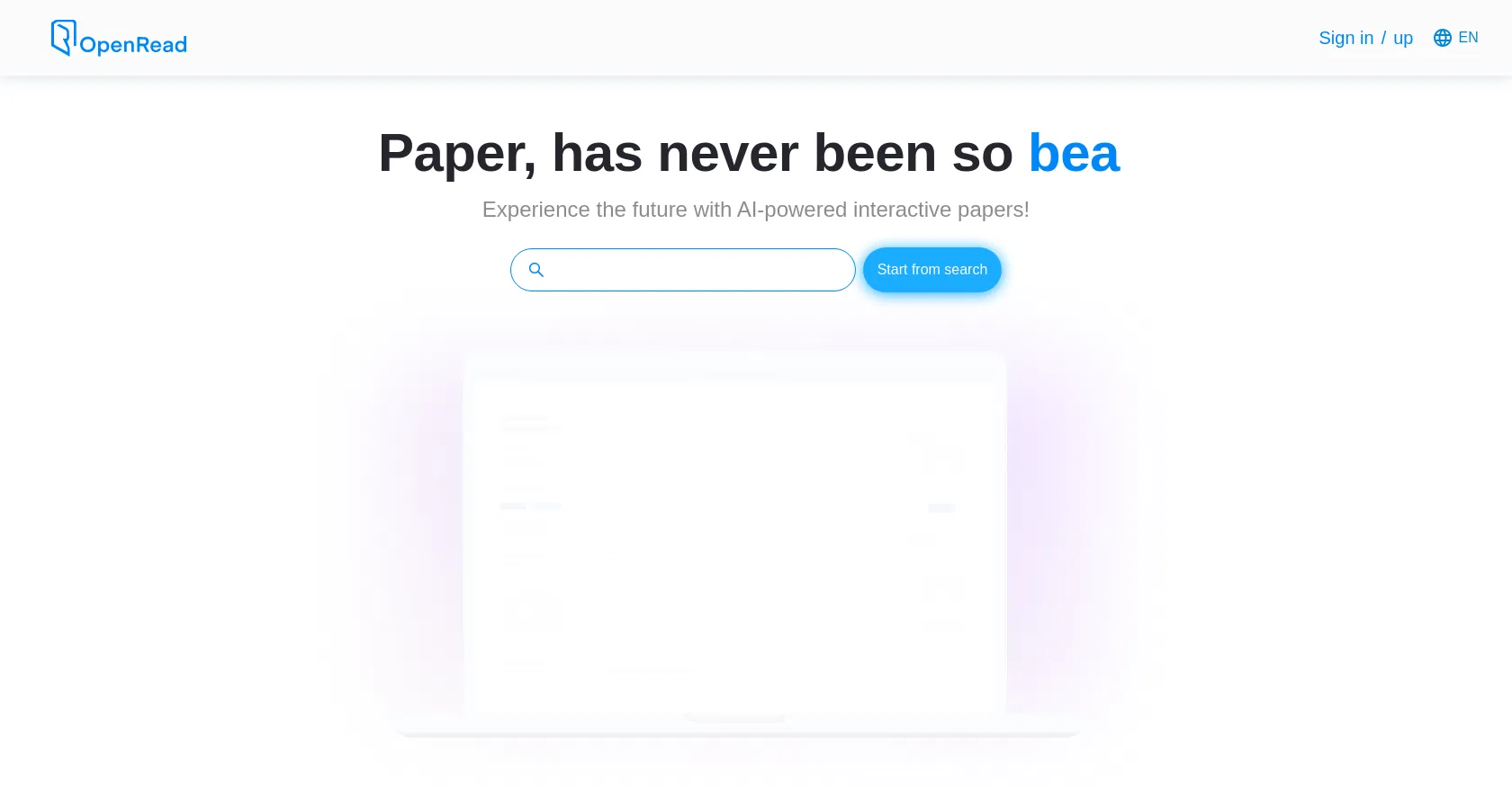
OpenRead is a specialized AI assistant for the scientific community, created by the company of the same name with a focus on accelerating the research process. Its main value lies in its ability to instantly extract and synthesize knowledge from millions of scientific articles, freeing scientists from the routine of reading mountains of PDF files. The service uses advanced natural language processing (NLP) models, likely based on transformers, for deep semantic understanding of academic texts.
Key features: the tool allows users to upload their own PDF articles and receive summaries, key point highlights, and answers to specific questions about the content. The system can perform semantic searches across an extensive database of scientific literature, finding relevant works even based on a description of an idea, not just keywords. A particularly powerful feature is the analysis of related articles through interactive Paper Espresso and connection graphs, which visualize the development of scientific concepts. Technically, the platform supports data extraction from tables and formulas, which is critically important for the exact sciences.
The uniqueness of OpenRead lies in its deep specialization in the academic format and the construction of a connected semantic knowledge network, rather than just text search. A special Q&A with documents feature allows for a dialogue with a specific article, asking clarifying questions about methods or results. The service offers both a free tier with basic functions and professional plans with extended limits and access to premium databases. The platform is accessible via a web interface, ensuring cross-platform compatibility without the need to install additional software.
It is ideally suited for graduate students, postdocs, professors, and research scientists in any discipline—from biomedicine to computer science. Specific use cases include writing a literature review for a dissertation, tracking the latest publications in one's field, quickly assessing the relevance of a found article for a current project, and preparing for a seminar presentation with a deep understanding of key works.
Key Features
Key Tags
Who It's For
Optimizing workflows
Generating ideas and experiments
No discussions yet.
Be the first to start a discussion!
Info
Best Prompts
No prompts yet. Be the first! OpenRead