MLflow
Manages the full machine learning and generative AI lifecycle, from experiments to deployment.
Description
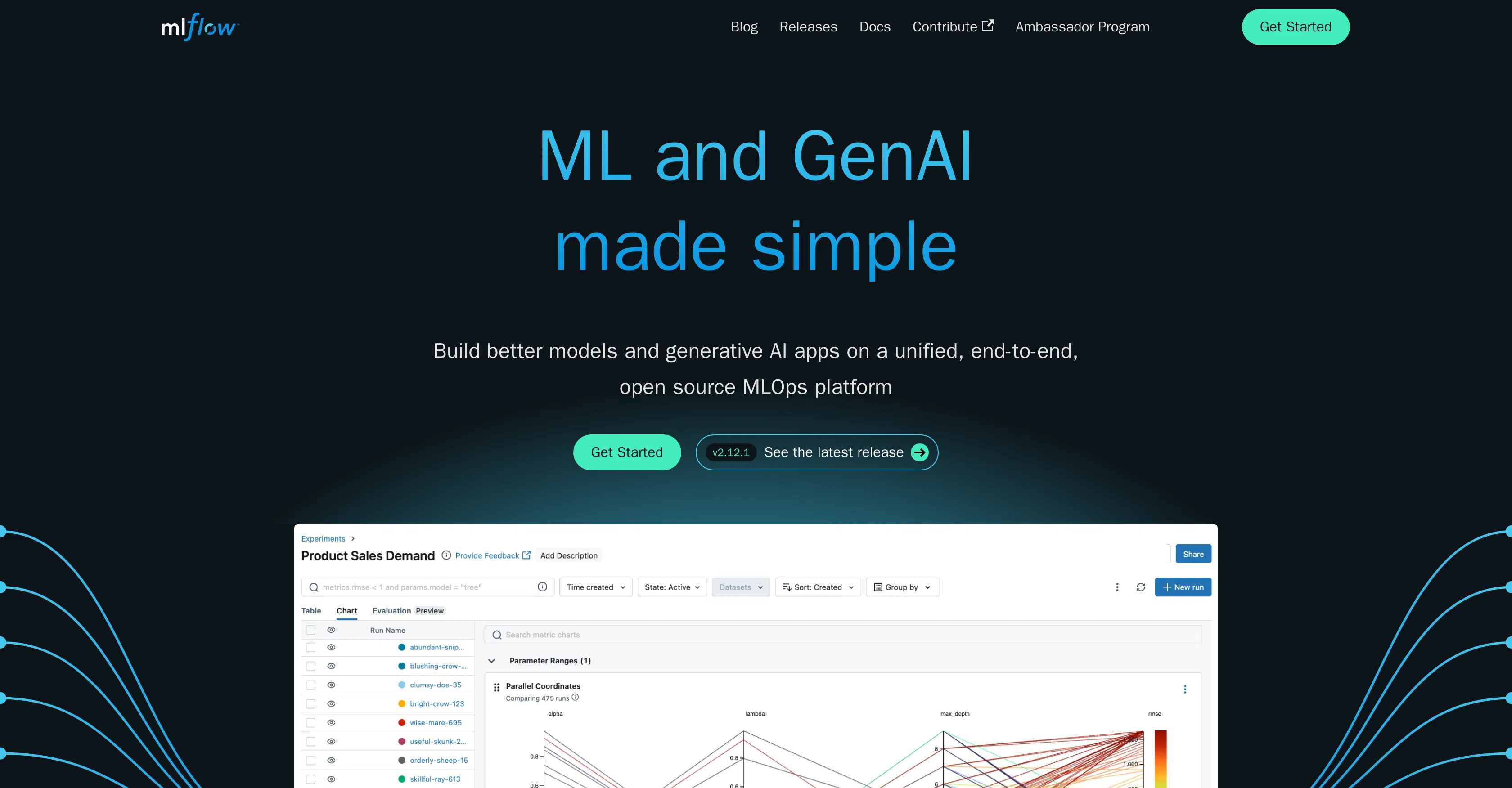
MLflow is an open-source MLOps platform originally created by Databricks but developed as an independent open-source project. Its core value lies in standardizing and simplifying the entire workflow for machine learning and generative AI models, enabling teams to efficiently manage experiments, versioning, deployment, and monitoring, significantly accelerating the path from idea to production application.
Key capabilities include: MLflow Tracking for logging experiment parameters, code, and metrics; MLflow Projects for packaging code into reproducible formats; MLflow Models for managing models and deploying them across various environments; and MLflow Model Registry as a central hub for collaborative model versioning, lifecycle stage management (staging, production), and annotations. The platform also offers tools for evaluating and monitoring LLM prompts and responses.
A key differentiator of MLflow is its framework and cloud provider agnosticism. It supports all popular machine learning libraries (TensorFlow, PyTorch, Scikit-learn, etc.) and generative AI tools, and integrates with cloud platforms (AWS, Azure, GCP) and orchestration tools (Kubernetes, Apache Spark). MLflow is available both as a local open-source version and as a managed service, MLflow AI Gateway from Databricks, offering deployment and scaling flexibility.
It is ideally suited for data scientists, ML engineers, and developers building and deploying machine learning models and generative AI applications into production. Use cases include tracking hundreds of experiments during hyperparameter tuning, managing model versions and smoothly transitioning them from staging to production, creating reproducible MLOps pipelines, and monitoring and managing prompts and responses of large language models in real-world applications.
Key Features
Key Tags
Who It's For
Optimizing workflows
Generating ideas and experiments
No discussions yet.
Be the first to start a discussion!
Info
Best Prompts
No prompts yet. Be the first! MLflow